
Getting stronger sounds wonderful.
Then real life has something to say about it.
As we age, strength training can become more complicated than many people expect. Recovery may slow down. Joints can feel stiffer. Old injuries sometimes start speaking up again. A sensitive back can turn a basic workout into a real concern. Energy may dip. Motivation can wobble when exercise feels more punishing than life-giving. Research on whole-body EMS has highlighted those exact challenges and described the method as a time-efficient, joint-friendly option for middle-aged and older adults, including people with musculoskeletal limitations.
That struggle is real.
A lot of adults still want to feel strong, toned, capable, and energized. What they do not want is to gamble with a vulnerable back, spend forever in the gym, or feel flattened for two days after one workout. Traditional strength training can start to feel less like empowerment and more like negotiation when your body no longer loves the old routine.
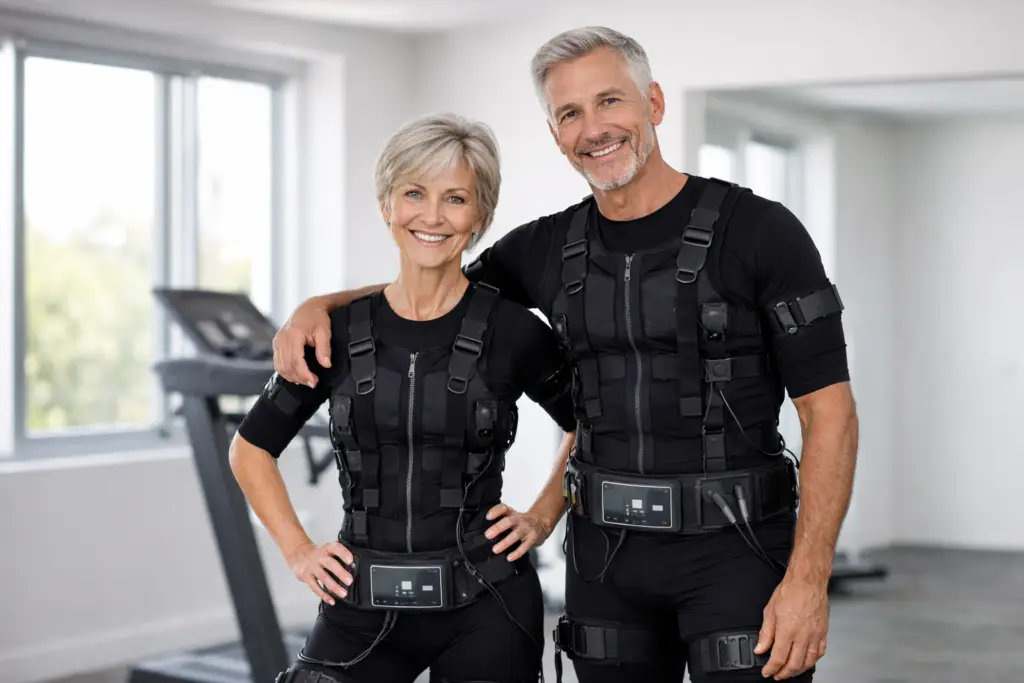
Instead of relying on heavy external weights, EMS uses controlled electrical muscle stimulation while you move through guided exercises. The suit helps activate major muscle groups in one short session. Manduu centers its model on 15-minute workouts, while BODY20 uses a 20-minute coach-led format with minimal joint stress.
That kind of efficiency matters.
That is where EMS muscle training stands out.
Busy adults do not always have an hour for the gym, plus commute time, plus shower time, plus recovery time. A workout that fits into real life has a much better chance of actually happening. Some EMS brands go even further and compare one session to several hours of conventional gym training. I would treat that as marketing shorthand for efficiency, not as a literal one-to-one promise for every person. Still, the main point holds up. EMS muscle training is designed to do a lot in a very short window.
That alone makes it a StarMaker.
Why strength training gets harder as we age
Bodies change.
Muscle loss becomes more relevant over time. Strength can decline if we do not actively maintain it. Back pain, mobility limits, joint wear, and general fatigue can make the old-school gym approach feel much less appealing than it once did. A recent systematic review focused specifically on whole-body EMS in middle-aged and older non-athletic adults and examined its usefulness for musculoskeletal conditions, including low back pain and sarcopenia-related concerns.
That matters because many people quietly blame themselves.
The problem is often not laziness. The problem is wear and tear, pain, time pressure, or a body that needs a wiser path. Needing a more manageable approach does not mean a person has failed. It means wisdom is finally leading the room.
Why EMS muscle training can help older adults and deconditioned people
Whole-body EMS has attracted attention partly because it is efficient and joint-friendly.
Those qualities matter even more for older adults and people who feel deconditioned. The 2024 review in the German Journal of Sports Medicine found positive evidence for WB-EMS in sarcopenia and chronic nonspecific low back pain in middle-aged and older adults. The authors also described WB-EMS as time-effective and joint-friendly, which helps explain why it is so appealing for people who cannot or do not want to train the traditional way.
That is encouraging.
For many people, the best workout is not the one that looks the toughest. The best workout is the one they can do safely, recover from well, and repeat consistently. EMS muscle training can fit that description beautifully.
Why EMS can make sense for back issues
This part is personal for me.
My husband and I both deal with back issues, so I pay close attention to training methods that may build strength without inviting unnecessary trouble. Traditional weights can be fantastic for some people. At the same time, a vulnerable back changes the math quickly. Heavy loading is not automatically wise just because it is popular.
EMS offers another route.
Your muscles still work hard. The session still feels real. Effort still shows up. What changes is how that effort gets delivered. BODY20 says its workout uses low-impact electrical impulses to activate multiple muscle groups at once while you move through simple exercises with a coach, all with minimal joint stress. Manduu describes its approach as ultra-low impact and gentle on joints, muscles, and tendons.
That difference matters for achy bodies.
The time savings are incredible
People naturally focus on results.
Honestly, the time savings deserve just as much attention. Manduu’s studio model centers on a 15-minute workout, and BODY20’s centers on 20 minutes. For adults juggling work, caregiving, healing, errands, and ordinary life fatigue, that kind of efficiency can remove one of the biggest barriers to consistency.
Shorter does not automatically mean easier.
In this case, it means focused.
That is one reason EMS muscle training feels like such a StarMaker. It respects the fact that many adults need fitness to fit into life, not take it over.
Can EMS muscle training burn a lot of calories?
This is another reason people get excited.
Some EMS marketing mentions high calorie-burn numbers, including claims in the 750-plus range for a session. I would not present that as a guaranteed outcome for every person because calorie burn varies by body size, intensity, duration, and context. The stronger and safer claim is that whole-body EMS can raise energy expenditure, and published research has found significantly higher energy expenditure during low-intensity resistance exercise with WB-EMS than without it.
That is still impressive.
So yes, EMS muscle training can burn a meaningful amount of calories in a short session. I just would not lock that into a universal promise.
Will you get sore?
Very possibly.
Muscles that work hard usually let you know about it. Some soreness is normal, especially in the beginning or after intensity changes. The good news is that the method does not rely on the same kind of heavy external loading that many people associate with gym-related wear and tear. That lower-impact angle is one reason both Manduu and BODY20 market their systems as joint-friendly.
In plain English, you may feel the workout.
You just may not feel as beaten up by the process.
Wet EMS suits versus dry EMS suits
This is where people often get confused.
Wet EMS suits use moisture on the electrode areas. Manduu explains that the process includes getting into the EMS suit, preparing the electrodes, and then completing the session with a trainer. That studio model appeals to many people because it gives them instruction, accountability, and a guided pace. BODY20 also uses a coach-operated studio format.
Dry suits work differently.
Visionbody describes its PowerSuit as a dry, wireless full-body EMS system designed for muscle activation in about 20 minutes. That is one reason I personally like Visionbody. The dry-suit route feels simpler, cleaner, and easier to work into normal life. Convenience is not a minor detail. In many cases, it is the very thing that turns good intentions into a real habit.
Mike Tyson used EMS during his Jake Paul training camp
That detail definitely raised curiosity.
Reporting around Tyson’s 2024 preparation for Jake Paul discussed electrical muscle stimulation as part of the mix during training camp. Tyson was 57 during that stretch of training and later fought Jake Paul in November 2024 at age 58.
That does not make EMS magical.
It does show this is not some fringe gimmick. Serious athletes and serious trainers notice tools that can save time, increase muscle activation, and reduce impact.
Benefits of EMS muscle training
Here is where the StarMaker part really shines.
- Saves time with full-body sessions in about 15 minutes at Manduu or 20 minutes at BODY20.
- Activates many muscle groups at once during guided movement.
- Offers a lower-impact path to strength than many traditional approaches.
- Can be helpful for older adults who still want to build or maintain strength.
- May feel more approachable for deconditioned people.
- Gives people with back issues another option besides heavy weights.
- Can raise energy expenditure in a short session.
- Fits real life better for busy adults.
- Comes in both wet-suit studio formats and dry wireless options.
- Can make strength training feel possible again for people who thought it had become too risky, too long, or too exhausting.
Who should not use EMS suits?
This part deserves calm honesty.
EMS is not right for everyone. The FDA’s guidance for powered muscle stimulators says they should not be used on patients with cardiac demand pacemakers, and the FDA also warns about possible risks such as shocks, burns, bruising, skin irritation, pain, and interference with important medical devices when products are unregulated or used improperly.
That means caution matters.
People with pacemakers, ICDs, or other implanted electronic devices should get medical guidance before using EMS. The American Heart Association also warns that certain devices and magnetic fields can interfere with pacemakers and ICDs. Pregnancy, recent surgery, acute illness, and certain neurological conditions may also require medical clearance first.
Wisdom first. Always.
Why EMS muscle training is such a StarMaker
A StarMaker is not about hype.
A StarMaker is something that helps you grow in a real-world way.
EMS muscle training can do that. It can help busy people reclaim time. Also, it can help older adults stay engaged in strength work. And, it can give de-conditioned people a less intimidating way to begin. It can even offer another route for those of us with back issues who do not always feel safe lifting heavy. Most of all, it can make strength feel possible again.
That matters because feeling strong changes more than muscles.
Confidence rises.
Hope comes back.
Momentum starts building again.
That sounds like a StarMaker to me.
My recommendation
Manduu and BODY20 both make sense for people who want instructor-led EMS training in a studio setting. Manduu focuses on a 15-minute, trainer-guided, ultra-low-impact format, while BODY20 focuses on a 20-minute coach-led workout.
For the dry-suit route, I personally use Visionbody.
I love the flexibility and simplicity. Also, I love that it makes strength training feel far more doable in real life. Visionbody describes its system as dry, wireless, and designed for full-body activation in about 20 minutes, which is exactly why it stands out for people who want more convenience.
Ready to explore EMS muscle training in a way that fits your life better?
Check out Visionbody: [VISIONBODY]
Start small. Stay grounded. Keep growing.
Isaiah 40:31 – But they who wait for the Lord shall renew their strength; they shall mount up with wings like eagles; they shall run and not be weary; they shall walk and not faint